Localizeflow / Operating case study
Taking translation updates all the way to the repository.
Building and operating the workflow around AI translation: running the work, tracking its progress and delivering changes as GitHub pull requests.
A product built and operated by Minseok Song
- Microsoft public repositories
- 14
- Linked pull requests verified
- 309
- Pull requests merged
- 283
An operational snapshot, checked against retained execution records and public GitHub results.
The challenge
A translation is only one part of the work.
Open-source learning content keeps changing. Updating its translations also means choosing the source content, following long-running jobs, investigating failures and getting the resulting changes back to each project.
The workflow needs to make that work visible from execution through delivery.
My contribution
Connecting the engine to day-to-day operations.
I build and operate Localizeflow and contribute to Co-op Translator, the open-source translation engine. Localizeflow connects repository-level translation jobs, execution records, a status interface and GitHub pull requests.
This brings translation execution and the changes delivered to a repository into one traceable workflow.
The implementation
From translation work to a reviewable change.
Choose the work
Identify the source content and translation targets for the repository.
Run the translation
Use Co-op Translator to carry out the AI-assisted translation work.
Track the execution
Keep progress, completion and failure states visible in Localizeflow.
Deliver the changes
Create or update a GitHub pull request. The repository retains control of acceptance and merging.
Technology used: Co-op Translator, Microsoft Foundry, Azure, GitHub, Python
The operating interface
Follow a run and open its pull request.
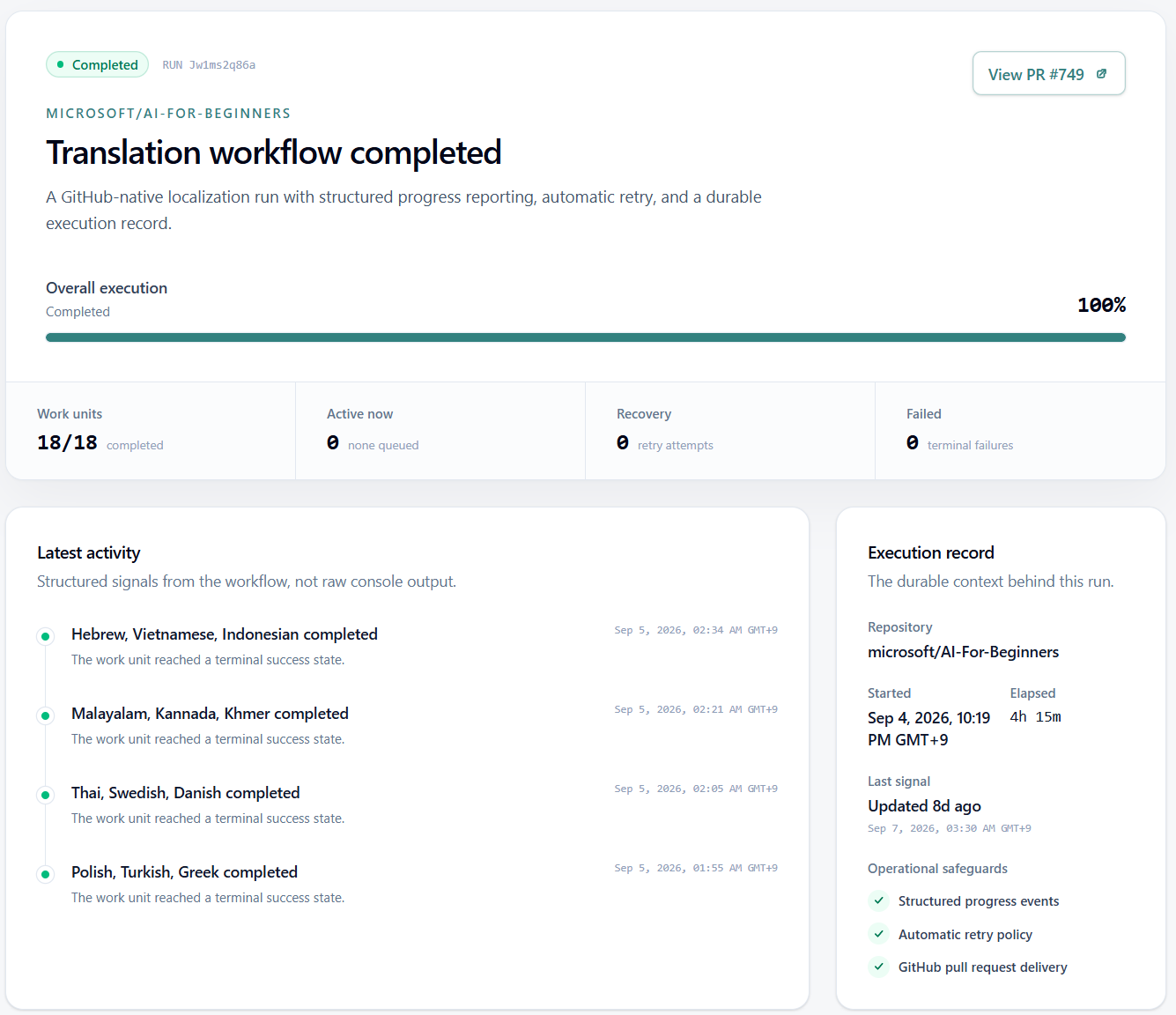
This public run for Microsoft AI-For-Beginners shows completion, work-unit counts and a link to the resulting pull request. Operators can see what finished and where the changes were delivered.
Open the public run record (opens in a new tab)The run links to PR #749, which was merged on November 3, 2026 (UTC). A pull request may collect changes from more than one run.
The results
Changes that reached real projects.
Of the 309 distinct pull requests linked to these execution records, 283 were merged. Here are three public examples you can inspect.
- View pull request: AI-For-Beginners #749 (opens in a new tab)
AI-For-Beginners #749
Merged (UTC)
- View pull request: MCP for Beginners #1089 (opens in a new tab)
MCP for Beginners #1089
Merged (UTC)
- View pull request: Generative AI for Beginners #1355 (opens in a new tab)
Generative AI for Beginners #1355
Merged (UTC)
How these figures were counted
The scope is 14 currently connected public Microsoft repositories with retained translation-job records. Distinct pull request URLs were collected from those records, and all 309 were checked on GitHub.
At the November 4, 2026 check, 283 were merged, 16 were closed without merging and 10 remained open. The verified pull requests were created between December 11, 2025 and November 3, 2026 (UTC). These are pull requests, not individual translated documents or customer organizations.
A merge records acceptance into the repository; it does not establish a separate website deployment. Automatic merging was disabled for these repositories at the time of the check. Time savings and translation accuracy were not measured in this review.
This is an operating case study of my own product in public open-source projects, not a paid Microsoft client engagement.
For a partner project
The experience extends beyond generating content.
This work connects an AI engine to execution tracking, an operator interface and a reviewable output in an existing system. Those are the implementation responsibilities I can bring to a defined part of your project.
Tell me what your team is working on and where you could use support. A short email is enough to start.
Email Minseok